
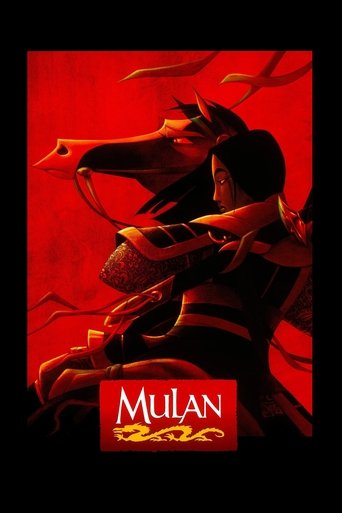
Mulan

Mulan é adequado para a sua família?

Filme 1998 88 min Analisado com a metodologia v1.1.0 — pode ser atualizado

Na antiga China, durante a guerra, todos os homens são convocados para lutar. Mas, um pobre velho, que pela idade não poderia mais lutar, descobre que sua filha Mulan toma o seu lugar, vestindo-se como homem e permanecendo em segredo. Se isso for descoberto, o castigo será severo. Agora, durante a guerra, Mulan ganha a proteção de um pequeno dragão, cuja missão é cuidar para que ela volte a salvo.

O que tem dentro

  • ViolênciaSignificativo · 61
    Por que essa pontuação?
    • 0:00–5:00Hun forces attack the Chinese empire, with depictions of invading armies and military conflict shown through animated battle sequences.claro
    • 20:00–40:00Military training sequences depict soldiers engaging in physical conditioning, combat drills, and hand-to-hand fighting practice.claro
    • 60:00–80:00A major battle sequence shows animated combat between the Chinese army and Hun invaders, featuring large-scale warfare with weapons and physical confrontation as the central focus.central

    Amostra das cenas identificadas. Descrições neutras, escritas pela Zelari.

  • Conteúdo sexualAusente · 0
  • Romance e relacionamentosPresente · 31
    Por que essa pontuação?
    • 80:00–88:00A heterosexual romantic relationship develops between the female protagonist and a male military captain, culminating in a kiss.claro

    Amostra das cenas identificadas. Descrições neutras, escritas pela Zelari.

  • Religião e espiritualidadeTraços · 5
    Por que essa pontuação?
    • 0:00–1:28The film is based on ancient Chinese folklore and mythology, establishing a fictional world with cultural and spiritual context.fundo

    Amostra das cenas identificadas. Descrições neutras, escritas pela Zelari.

  • Temas familiaresTraços · 24
    Por que essa pontuação?
    • 0:00–1:28A young woman takes her father's place in the military after he receives a conscription order, indicating a father-daughter relationship and family obligation.claro
    • 0:00–1:28The father is described as ailing, suggesting he has a health condition that affects family dynamics and decisions.leve

    Amostra das cenas identificadas. Descrições neutras, escritas pela Zelari.

  • Mensagens políticas e sociaisSignificativo · 58
    Por que essa pontuação?
    • 0:00–88:00A young woman challenges gender norms by disguising herself as a man to serve in the military in place of her father, addressing themes of familial duty, gender roles, and individual identity.claro
    • 0:00–88:00The narrative presents a female character who proves herself capable in a traditionally male-dominated military context, demonstrating competence equal to male soldiers.leve
    • 0:00–88:00The story depicts an imperial system requiring mandatory military service from families to defend the nation against foreign invasion.leve

    Amostra das cenas identificadas. Descrições neutras, escritas pela Zelari.

  • Conteúdo emocional pesadoTraços · 23
    Por que essa pontuação?
    • 0:00–1:28The film involves an impending military invasion that creates background peril for the protagonist and her family.leve
    • 0:00–1:28The protagonist experiences sustained tension from the risk of execution if her gender disguise is discovered during military service.claro
    • 0:00–1:28The film depicts the protagonist's concern for her elderly father's health and inability to serve in the military.leve

    Amostra das cenas identificadas. Descrições neutras, escritas pela Zelari.

Reanalisar

Onde os temas aparecem

0 min88 min
Violência
Conteúdo sexual
Romance e relacionamentos
Religião e espiritualidade
Temas familiares
Mensagens políticas e sociais
Conteúdo emocional pesado

Posição aproximada de cada cena ao longo da duração.

Representação (informativo)

Estas informações são exibidas apenas para conhecimento — nunca usadas como filtro.

  • Protagonismo feminino: Presente
  • Diversidade no elenco
  • Personagens LGBTQ presentes

As pontuações medem a presença de temas (0–100) — nunca dizem se o conteúdo é bom ou ruim. Famílias diferentes têm critérios diferentes.