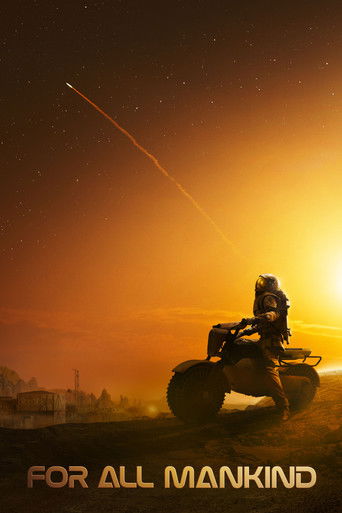
For All Mankind

Is For All Mankind right for your family?

Series 2019 70 min/ep. Analyzed with methodology v1.7.0 — can be updated

Explore an aspirational world where NASA and the space program remained a priority and a focal point of our hopes and dreams as told through the lives of NASA astronauts, engineers, and their families.

What's inside

Average score of the 2 episodes analyzed so far. 48 more episodes can be analyzed for a more accurate picture.

  • ViolenceTraces · 12
  • Sexual contentTraces · 16
  • Romance & relationshipsPresent · 39
  • Religion & spiritualityTraces · 18
  • Family themesPresent · 37
  • Political & social messagingSignificant · 64
  • Heavy emotional contentPresent · 49
  • Educational contentTraces · 24

Re-analyze

Representation (informational)

Shown for information only — never used as a filter.

  • Female protagonism: Present
What we identified — Female protagonism

The series features women in leadership positions as NASA astronauts and engineers, following their career paths throughout the episodes.

  • Cast diversity: Present
What we identified — Cast diversity

The series includes people of different ethnicities and backgrounds in the main cast, including Black women in prominent roles.

  • LGBTQ characters present: Present
What we identified — LGBTQ characters present

The series includes lesbian characters among the main cast.

  • Neurodivergence represented
  • Christianity
  • Islam
  • Judaism
  • Dharmic religions
  • Afro-diasporic & indigenous spiritualities
  • Mythology & folklore
  • Generic spirituality

Scores measure theme presence (0–100) — they never say whether content is good or bad. Different families have different thresholds.

Seasons & episodes

2 of 10 episodes analyzed — season average: Political & social messaging 64 · Heavy emotional content 49 · Romance & relationships 39 · Family themes 37

Ep. 1Red Moon65 minPolitical & social messaging 65can be updated
  • Political & social messagingSignificant · 65
    Why this score?
    • 0:00–65:00The narrative explores geopolitical competition between the United States and the Soviet Union during the space race, presenting political tensions and nationalism of both superpowers.clear
    • 0:00–65:00The episode addresses themes of national pride, technological capability, and international prestige as central social issues for national identity and power.clear

    Sample of identified scenes. Neutral descriptions, written by Zelari.

  • Heavy emotional contentPresent · 41
    Why this score?
    • 0:00–5:00NASA personnel learn that the Soviets reached the moon first, creating institutional and personal concern.clear
    • 5:00–20:00Characters experience emotional strain while dealing with the political and professional consequences of losing the space race.clear

    Sample of identified scenes. Neutral descriptions, written by Zelari.

  • ViolenceTraces · 24
    Why this score?
    • 0:00–2:00Scenes of rocket launches and space operations with references to Cold War competition between superpowers.mild
    • 30:00–32:30Political and military discussions regarding the American response to Soviet advancement in the space race.mild

    Sample of identified scenes. Neutral descriptions, written by Zelari.

  • Romance & relationshipsTraces · 22
    Why this score?
    • 20:40–21:20A male character kisses his wife before departing for a mission.mild
    • 48:10–49:10A heterosexual couple has a tense conversation about professional commitments.mild

    Sample of identified scenes. Neutral descriptions, written by Zelari.

  • Family themesTraces · 17
    Why this score?
    • 0:00–1:05The episode includes brief references to family structures and relationships of characters working in the space program.mild

    Sample of identified scenes. Neutral descriptions, written by Zelari.

  • Religion & spiritualityTraces · 17
    Why this score?
    • 26:00–27:00An American astronaut prays before the launch of his space mission.mild

    Sample of identified scenes. Neutral descriptions, written by Zelari.

  • Educational contentTraces · 5
    Why this score?
    • 0:00–1:05The episode presents an alternate historical scenario about the space race without structured educational content or cognitive skill exercises.background

    Sample of identified scenes. Neutral descriptions, written by Zelari.

  • Sexual contentAbsent · 0

Where themes appear

0 min65 min
Educational content
Family themes
Heavy emotional content
Political & social messaging
Religion & spirituality
Romance & relationships
Violence
Cast diversity

Representation (informational)

  • Cast diversity: Present
What we identified — Cast diversity

The main cast includes characters of different backgrounds and ethnicities, reflecting the diverse composition of NASA and 1960s American society.

  • Female protagonism
  • LGBTQ characters present
  • Neurodivergence represented
  • Christianity
  • Islam
  • Judaism
  • Dharmic religions
  • Afro-diasporic & indigenous spiritualities
  • Mythology & folklore
  • Generic spirituality

Re-analyze

Ep. 2He Built the Saturn V62 minPolitical & social messaging 63
  • Political & social messagingSignificant · 63
    Why this score?
    • 5:24–8:30Debate over militarization of the space program, with von Braun opposing construction of a military lunar base under pressure from President Nixon.clear
    • 9:00–11:00Political scene depicting Nixon expressing frustration with von Braun and seeking strategies to remove him from NASA leadership.clear
    • 30:00–34:00Congressional hearing where Ed Baldwin testifies about von Braun's Apollo 10 decisions, with questions about caution versus risk in the space program.clear

    Sample of identified scenes. Neutral descriptions, written by Zelari.

  • Family themesSignificant · 56
    Why this score?
    • 6:00–7:00A woman converses with her father about relationship concerns and marriage possibilities.mild
    • 9:00–11:00A mother reprimands her daughter for dangerous fire-related behavior while the father attempts communication.mild
    • 19:00–21:00A wife expresses anger and divorce desire while confronting her astronaut husband's infidelity.clear

    Sample of identified scenes. Neutral descriptions, written by Zelari.

  • Heavy emotional contentSignificant · 56
    Why this score?
    • 0:46–1:46Sustained tension during lunar module liftoff procedure with concerns about stability and insufficient fuel margin for rendezvous.clear
    • 5:04–6:11Woman in emotional distress discussing separation and divorce, expressing fear about social stigma and financial consequences of leaving her husband.clear
    • 7:12–8:59Distressed adolescent refuses to communicate and reveals compulsive fire-setting behavior, expressing internal emotional turmoil.clear

    Sample of identified scenes. Neutral descriptions, written by Zelari.

  • Romance & relationshipsSignificant · 56
    Why this score?
    • 18:00–20:00An older woman suggests to a young man that he should date someone romantically, and he responds that he doesn't have time for relationships.mild
    • 25:30–27:00A heterosexual couple has a tense conversation about infidelity; the woman mentions hearing another person's voice in the room during a phone call.clear
    • 31:00–34:00A married woman confesses to a friend that she fantasizes about being married to another man and they discuss the difficulties of marriage to astronauts.clear

    Sample of identified scenes. Neutral descriptions, written by Zelari.

  • Educational contentPresent · 43
    Why this score?
    • 0:00–0:36Technical explanation of the phases of a lunar voyage, including orbital dynamics and fuel consumption.clear
    • 0:06–0:08Reference to intelligence information regarding Soviet military capabilities in space.mild
    • 0:12–0:30Congressional hearing examining decisions regarding the Apollo program and Saturn V rocket production cancellation.mild

    Sample of identified scenes. Neutral descriptions, written by Zelari.

  • Sexual contentPresent · 32
    Why this score?
    • 0:09–0:11Woman romantically suggests that a man should find a partner.mild
    • 0:15–0:16Supervisor makes implicit questioning about a woman's personal life and relationships.mild
    • 0:20–0:22Woman mentions a fantasy about being married to another man.mild

    Sample of identified scenes. Neutral descriptions, written by Zelari.

  • Religion & spiritualityTraces · 18
    Why this score?
    • 0:43–0:48Von Braun references 'God' when discussing the expansion of human mind and divine capabilities.mild
    • 53:32–53:37Nixon uses figurative language about 'red moon' and 'blue moon' when discussing geopolitical competition.background

    Sample of identified scenes. Neutral descriptions, written by Zelari.

  • ViolenceAbsent · 0

Where themes appear

0 min62 min
Educational content
Family themes
Heavy emotional content
Political & social messaging
Religion & spirituality
Romance & relationships
Sexual content
Cast diversity
Female protagonism
Neurodivergence represented

Representation (informational)

  • Female protagonism: Present
What we identified — Female protagonism

Margo Madison is a central protagonist, an engineer who becomes the first woman in Mission Control. Her narrative arc is significant, including professional and personal challenges.

  • Cast diversity: Present
What we identified — Cast diversity

The cast includes characters from diverse backgrounds: American astronauts, German engineers (von Braun), NASA staff, and families of different ethnic and cultural backgrounds.

  • Neurodivergence represented: Present
What we identified — Neurodivergence represented

Aleida, daughter of Molly Cobb, displays obsessive and compulsive behavior, repeatedly deliberately setting fires despite warnings. Her father questions her behavior and she expresses difficulty communicating her emotional needs.

  • Generic spirituality: Present
What we identified — Generic spirituality

Von Braun makes references to 'ideology' and spiritual purpose, describing space work as 'expanding the mind of man' and reaching 'outermost limits.' He also mentions 'destiny' and hope in space exploration.

  • LGBTQ characters present
  • Christianity
  • Islam
  • Judaism
  • Dharmic religions
  • Afro-diasporic & indigenous spiritualities
  • Mythology & folklore
Ep. 3Nixon's Women62 minnot analyzed
Ep. 4Prime Crew62 minnot analyzed
Ep. 5Into the Abyss60 minnot analyzed
Ep. 6Home Again60 minnot analyzed
Ep. 7Hi Bob60 minnot analyzed
Ep. 8Rupture58 minnot analyzed
Ep. 9Bent Bird48 minnot analyzed
Ep. 10A City Upon a Hill76 minnot analyzed

Ep. 1Every Little Thing57 minnot analyzed
Ep. 2The Bleeding Edge56 minnot analyzed
Ep. 3Rules of Engagement60 minnot analyzed
Ep. 4Pathfinder61 minnot analyzed
Ep. 5The Weight58 minnot analyzed
Ep. 6Best-Laid Plans60 minnot analyzed
Ep. 7Don't Be Cruel62 minnot analyzed
Ep. 8And Here's to You70 minnot analyzed
Ep. 9Triage56 minnot analyzed
Ep. 10The Grey77 minnot analyzed

Ep. 1Polaris62 minnot analyzed
Ep. 2Game Changer65 minnot analyzed
Ep. 3All In61 minnot analyzed
Ep. 4Happy Valley55 minnot analyzed
Ep. 5Seven Minutes of Terror67 minnot analyzed
Ep. 6New Eden64 minnot analyzed
Ep. 7Bring It Down61 minnot analyzed
Ep. 8The Sands of Ares67 minnot analyzed
Ep. 9Coming Home50 minnot analyzed
Ep. 10Stranger in a Strange Land85 minnot analyzed

Ep. 1Glasnost71 minnot analyzed
Ep. 2Have a Nice Sol56 minnot analyzed
Ep. 3The Bear Hug74 minnot analyzed
Ep. 4House Divided62 minnot analyzed
Ep. 5Goldilocks60 minnot analyzed
Ep. 6Leningrad59 minnot analyzed
Ep. 7Crossing the Line46 minnot analyzed
Ep. 8Legacy55 minnot analyzed
Ep. 9Brazil50 minnot analyzed
Ep. 10Perestroika81 minnot analyzed

Ep. 1First Light59 minnot analyzed
Ep. 2The Hard Six46 minnot analyzed
Ep. 3Home60 minnot analyzed
Ep. 4Open Source57 minnot analyzed
Ep. 5Svoboda53 minnot analyzed
Ep. 6No Sudden Moves49 minnot analyzed
Ep. 7The Sirens of Titan52 minnot analyzed
Ep. 8Brave New World53 minnot analyzed
Ep. 9Sons and Daughters44 minnot analyzed
Ep. 10This Land Is Our Land70 minnot analyzed